Species Database
Wildlife of Britain & Beyond
Browse species profiles, conservation statuses, and seasonal information. Spot something not in the database? Submit a new species for review.
65 species in Plants
Submit a new speciesAlder
LCAlnus glutinosa
Britain's wetland tree par excellence, growing along riversides, in fens and wet woodland. Its roots fix nitrogen and its waterlogged wood resists decay — Venice is built on alder piles. It is the primary food plant of the alder kitten moth.
Aspen
LCPopulus tremula
The aspen's leaves tremble in even the lightest breeze due to their flattened leaf stalks, giving rise to its common name. An ancient, native tree that spreads through root suckers, forming clonal thickets that support rare lichens and insects.
Bee Orchid
LCOphrys apifera
One of Britain's most extraordinary wildflowers. The lip of each flower mimics a female bee in shape and scent to attract male bees for pollination. In Britain, however, it usually self-pollinates and appears magically on calcareous grassland, old quarries and road verges.
Bell Heather
LCErica cinerea
Bell heather flowers earlier than ling, from July, with vivid purple-red bell-shaped flowers. It grows on drier, more acidic ground within heathlands and is an important nectar source for bees. Historically used for brooms, thatching and dyes.
Bird's-foot Trefoil
LCLotus corniculatus
One of Britain's most important wildflowers for insects, with over 130 species of invertebrates associated with it. Its butter-yellow and red-streaked flowers earned it nicknames including 'eggs and bacon'. The seed pods resemble a bird's claw.
Blackthorn
LCPrunus spinosa
Blackthorn blooms early — white flowers before the leaves open in March — making it a key early nectar source. The sloe berries are used for sloe gin. Its sharp thorns make it excellent for stock-proof hedging and nesting cover for birds.
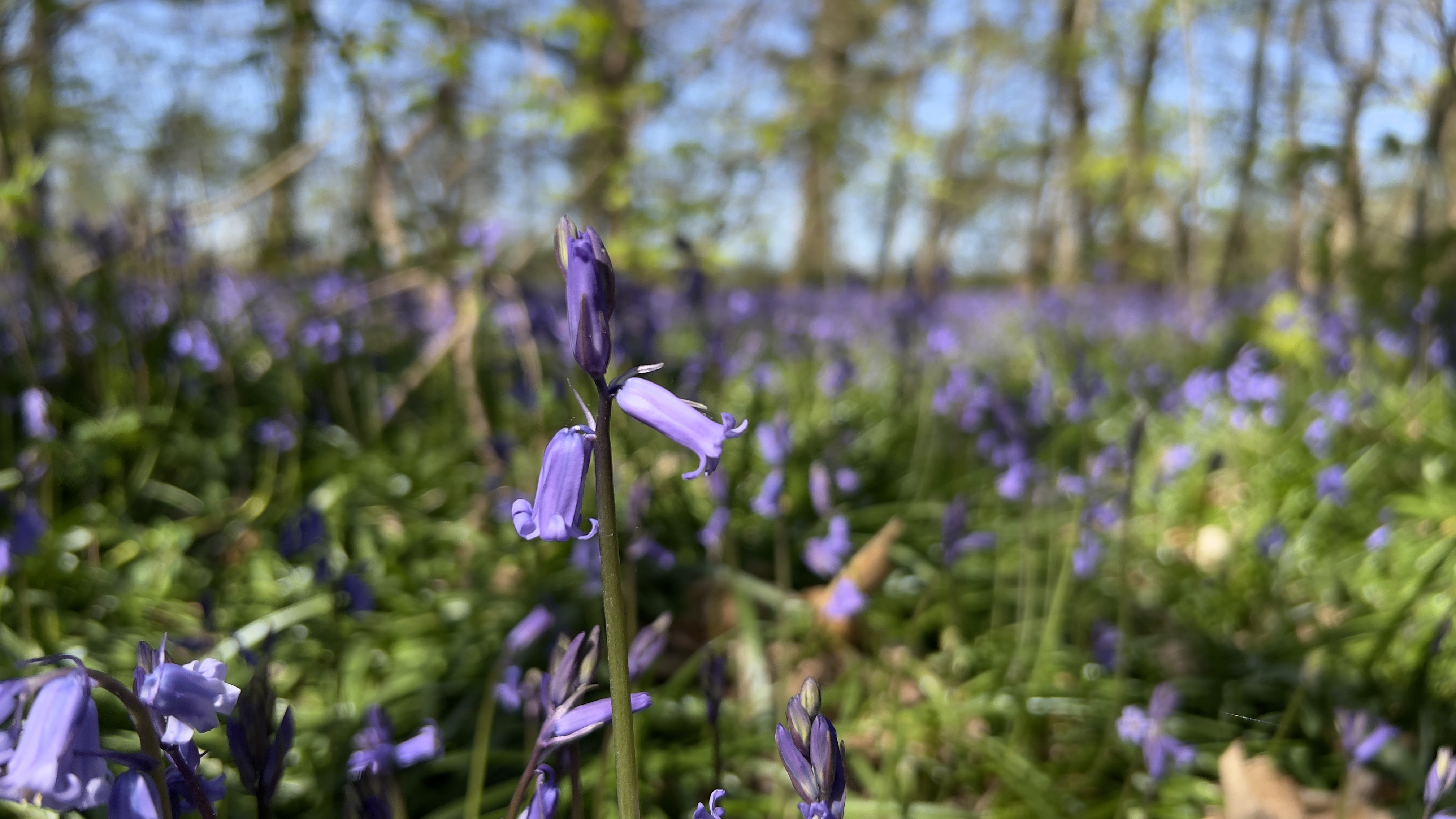
Bluebell
LCHyacinthoides non-scripta
Britain holds half the world's population of native bluebells. The blue carpet of an ancient oak wood in late April is one of Britain's most celebrated wildlife sights. It is protected by law as native specimens are under threat from the Spanish bluebell hybrid.
Bogbean
LCMenyanthes trifoliata
A beautiful aquatic plant of shallow peat bogs, fens and shallow lakes, with distinctive fringed white flowers above three-parted leaves. An important indicator of good quality wetland. Once used as a hop substitute in brewing bitter beer.
Bracken
LCPteridium aquilinum
Britain's most widespread fern and the country's only native plant that forms monocultures over large areas. Its deep litter provides shelter for adders and lizards. Bracken encroachment is a major management issue on heathlands and moorland.
Bulrush
LCTypha latifolia
The classic wetland plant, with brown sausage-shaped seed heads that explode to release thousands of seeds on the wind. Its dense stands provide cover for reed buntings, warblers and bitterns and its stems and roots are eaten by water voles.
Common Ash
CRFraxinus excelsior
Once one of Britain's most abundant trees, ash is now critically threatened by ash dieback (Hymenoscyphus fraxineus), a fungal disease that could kill 80% of ash trees in the UK. Ancient ash woodlands on limestone are particularly at risk.
Common Dog-violet
LCViola riviniana
The most widespread violet in Britain, found in woodland edges, hedgebanks and grassland. Unlike sweet violet it has no scent. It is the larval food plant of pearl-bordered, small pearl-bordered and dark green fritillary butterflies.
Common Juniper
NTJuniperus communis
Britain's only native juniper, once widespread on chalk downland and limestone, now in steep decline. Its berries (used to flavour gin) are eaten by birds and it provides dense cover for nesting birds. Native to a wider range than any other tree.
Common Knapweed
LCCentaurea nigra
One of Britain's most valuable late-summer wildflowers for insects, knapweed's purple thistle-like flowers attract over 40 species of butterfly and over 100 species of bee and hoverfly. It is a key species for wildflower meadow restoration mixes.
Common Poppy
LCPapaver rhoeas
The field poppy flourishes in disturbed soil and arable field margins, becoming an iconic symbol of remembrance. It declined dramatically with herbicide use but is recovering with agri-environment schemes. Its seeds can remain viable in soil for over 80 years.
Common Reed
LCPhragmites australis
Britain's tallest grass forms extensive reedbed habitats that are home to some of our rarest birds including bittern, marsh harrier and bearded tit. Reed is still harvested for thatching, with Norfolk reed considered the finest quality available.
Common Spotted Orchid
LCDactylorhiza fuchsii
Britain's most widespread orchid, found in woodland rides, grassland, road verges and old quarries. The pink-mauve flowers have intricate darker markings and the leaves are spotted with purple. It often forms large colonies.
Common Teasel
LCDipsacus fullonum
The teasel's architectural seed heads persist through winter and are one of the most important food sources for goldfinches, which perch acrobatically to extract the seeds. The dried heads were traditionally used to raise the nap on wool cloth.
Common Yew
LCTaxus baccata
The longest-lived tree in Britain — ancient churchyard yews may be over 5,000 years old. Almost all parts are highly poisonous except the red aril surrounding the seed. The taxol compound derived from it is used in cancer treatment.
Cowslip
LCPrimula veris
A plant of unimproved chalk grassland, meadows and road verges, the cowslip has made a comeback following protection from picking and more sympathetic road-verge management. Its nodding yellow flowers are an important nectar source for early butterflies.
Crab Apple
LCMalus sylvestris
The ancestor of all cultivated apple varieties, the crab apple is a small, thorny native tree of hedgerows and woodland edges. Its tart, bitter apples are eaten by fieldfares, foxes and badgers and were traditionally used to make verjuice.
Devil's-bit Scabious
LCSuccisa pratensis
The sole food plant of the marsh fritillary butterfly and an important nectar source for many other species. Blue-purple flowers on long stalks appear in late summer in damp meadows, fen edges and woodland rides. The name refers to its bitten-off root.
Downy Birch
LCBetula pubescens
More tolerant of wet and acidic soils than silver birch, the downy birch is the dominant birch in Scotland, Ireland and upland Britain. The twigs have soft hairs (downy) rather than the warty growths of silver birch.
Early Purple Orchid
LCOrchis mascula
One of Britain's earliest orchids to flower, appearing in April and May in ancient woodland, chalk downland and limestone pavement. The dark purple flowers have a strong, somewhat unpleasant scent that attracts queen bumblebees.
Elder
LCSambucus nigra
A fast-growing, short-lived tree of hedgerows, woodland edges and disturbed ground. Elderflowers are used for cordials and elderberries for wine and syrup. Its berries are vital for migrant birds and it supports over 90 insect species.
English Oak
LCQuercus robur
Britain's most ecologically important tree, supporting over 2,300 species of invertebrates, lichens, birds and mammals — more than any other native species. It can live for over 1,000 years and acorns were a staple food for pigs for centuries.
European Beech
LCFagus sylvatica
Britain's most stately broadleaved tree, forming cathedral-like ancient woodlands on chalk and limestone downland. Beech mast (nuts) in mast years provides vital food for wood mice, squirrels, jays and woodland finches.
Field Maple
LCAcer campestre
Britain's only native maple, common in hedgerows and woodland edges on chalky soils. The leaves turn brilliant gold and orange in autumn. It is an important nectar source for insects and its winged seeds spin like helicopters when falling.
Foxglove
LCDigitalis purpurea
A tall, stately plant of woodland clearings, hedgebanks and acid grassland, the foxglove's pink-purple tubular flowers are perfectly shaped for bumblebees to enter and gather nectar. The heart medicine digitalis is derived from it.
Goat Willow
LCSalix caprea
Also known as pussy willow or sallow, the goat willow's fat yellow catkins are one of the most important early pollen sources for queen bumblebees and other bees emerging from hibernation in March. Caterpillars of purple emperor butterflies feed on it.
Gorse
LCUlex europaeus
Gorse is said to smell like coconut and there is a saying that 'when gorse is out of bloom, kissing is out of fashion' — it flowers in some measure year-round. It provides dense nesting cover for stonechats, linnets and yellowhammers.
Greater Stitchwort
LCStellaria holostea
A delicate plant of hedgebanks and woodland edges, its white star-like flowers are one of the most characteristic sights of spring roadsides. The weak, brittle stems lean on surrounding vegetation for support.
Harebell
LCCampanula rotundifolia
The Scottish bluebell and one of Britain's most delicate wildflowers, with nodding pale blue bells on thread-like stems. It grows on dry, calcareous grassland and heathland, and is pollinated by bumblebees which vibrate the flowers to release pollen.
Hart's Tongue Fern
LCAsplenium scolopendrium
Unlike most ferns, the hart's tongue has undivided, strap-shaped fronds. It is common in shaded, lime-rich habitats — old walls, limestone pavement and damp woodland — and is evergreen, providing winter greenery on dark woodland floors.
Hawthorn
LCCrataegus monogyna
One of Britain's most important hedgerow trees, providing dense, thorny cover for nesting birds and abundant red berries (haws) for winter thrushes and fieldfares. The May blossom is one of the most characteristic sights of the British countryside.
Hazel
LCCorylus avellana
A versatile tree of hedgerows and woodland understorey, traditionally coppiced on rotation to produce poles and hurdles. Catkins provide early pollen for bumblebees in February, and hazelnuts are a vital autumn food for dormice and squirrels.
Heather
LCCalluna vulgaris
Ling heather defines the British moorland landscape, turning upland hills purple from August. It is the primary food source for red grouse and supports a suite of specialist invertebrates. In Norse mythology, heather grew where no other plant would.
Holly
LCIlex aquifolium
Britain's most familiar evergreen tree, with glossy, spiny leaves and bright red winter berries beloved by mistle thrushes and blackbirds. Only female trees bear berries. Holly was a sacred tree to the druids and features heavily in winter festivals.
Hornbeam
LCCarpinus betulus
A native tree of south-east England, the hornbeam has some of the hardest wood of any British tree. Pollarded hornbeams in Epping Forest are among Britain's most ancient managed trees, some dating back 500 years or more.
Lady's Smock
LCCardamine pratensis
Also known as cuckooflower, lady's smock flowers when the cuckoo arrives and is the primary larval food plant of the orange-tip butterfly. Pale lilac blooms appear in damp meadows and stream margins in April and May.
Male Fern
LCDryopteris filix-mas
One of Britain's most familiar woodland ferns, growing in large, vase-shaped clumps in hedgebanks and woodland. It is semi-evergreen, the fronds unfurling as 'croziers' in spring. The rhizome was once used as a tapeworm remedy.
Marsh Marigold
LCCaltha palustris
One of the first and showiest flowers of spring wetlands, the marsh marigold's large, golden blooms appear in March and April along riverbanks, marshes and wet woodland. It is an important early nectar source for queen bumblebees.
Meadow Buttercup
LCRanunculus acris
The most familiar buttercup of traditional hay meadows and damp grassland. Its golden flowers in May and June indicate unimproved grassland with good botanical diversity. Children test if their friends like butter by reflecting the shiny petals under the chin.
Meadowsweet
LCFilipendula ulmaria
The queen of meadow plants, meadowsweet fills damp meadows and riverbanks with creamy-white, sweetly scented flower heads from June to September. Aspirin was derived from a compound first isolated from it. It is the food plant of many moth caterpillars.
Primrose
LCPrimula vulgaris
One of the first flowers of spring, the primrose is a symbol of hope and renewal in British culture. It grows in woodland edges, hedge banks and meadows, and its pale yellow flowers are an important early nectar source for brimstone butterflies.
Purple Loosestrife
LCLythrum salicaria
A tall, spectacular plant of riverbanks and reedbeds, creating vivid pink-purple stands in late summer. It supports over 40 insect species and the flowers are visited constantly by bumblebees and other pollinators. Invasive in North America.
Pyramidal Orchid
LCAnacamptis pyramidalis
A spectacular chalk and limestone orchid with a dense, cone-shaped head of deep pink flowers. It is pollinated by butterflies and moths, which are attracted by its sweet scent. It can appear suddenly in large numbers on newly managed grassland.
Ragged Robin
LCSilene flos-cuculi
A waterside plant of wet meadows and fens, the ragged robin has distinctive pink flowers with deeply divided petals that give it its name. It has declined significantly with the drainage of wet meadows but is a flagship species for wetland restoration.
Rowan
LCSorbus aucuparia
The rowan or mountain ash grows at higher altitudes than almost any other British tree. Its brilliant orange-red berry clusters in late summer are devoured by redwings and other thrushes. It was planted beside houses to ward off witches.
Royal Fern
LCOsmunda regalis
Britain's largest and most spectacular fern, reaching 2 metres in wet woodland and bog margins. The fertile fronds have bright rust-coloured spore-bearing pinnae at their tips, resembling a royal sceptre. It has declined with drainage of wetlands.
Scots Pine
LCPinus sylvestris
Britain's only native pine and one of its most ancient trees. The native Caledonian pinewoods of Scotland are among the world's rarest ecosystems, supporting red squirrels, crested tits and Scottish crossbills.
Sessile Oak
LCQuercus petraea
The dominant oak of western and upland Britain, particularly in Wales and Scotland, the sessile oak forms the canopy of ancient Atlantic rainforests draped in mosses and lichens. Its acorns lack stalks (peduncles) — the distinguishing feature from English oak.
Silver Birch
LCBetula pendula
One of Britain's most graceful trees, with distinctive white bark and pendulous branches. It is a pioneer species, rapidly colonising bare ground and heathland. It supports over 300 insect species and is important for woodland creation.
Small-leaved Lime
LCTilia cordata
A native lime tree and one of Britain's most ancient woodland species, dominant in the so-called lime-wood zone stretching across the East Midlands. It is a magnificent insect tree, with fragrant flowers that attract bees in abundance in summer.
Sweet Chestnut
LCCastanea sativa
Introduced by the Romans as a food source, the sweet chestnut produces large, edible nuts in spiny cases and can live for over 500 years. Ancient coppiced sweet chestnut woodlands in Kent and East Sussex are important habitats for wildlife.
White Water-lily
LCNymphaea alba
Britain's most spectacular aquatic plant, with large white flowers floating on pond and lake surfaces in summer. The floating leaves provide shelter for fish and amphibians and platforms for basking invertebrates and reed warblers.
White Willow
LCSalix alba
A tall, graceful tree of riverbanks and floodplains, its leaves shimmering silver in a breeze. Cricket bats are traditionally made from a cultivated variety. White willow is an important early nectar source and nesting habitat for birds.
Wild Cherry
LCPrunus avium
A beautiful native tree with spectacular white blossom in April and small, bitter cherries in summer. The ancestor of cultivated cherries, it has valuable, attractive timber and in autumn the leaves turn brilliant red and gold.
Wild Garlic
LCAllium ursinum
Forming dense, aromatic carpets in damp, ancient woodland in spring, the smell of wild garlic is one of the most evocative woodland scents. The white flowers attract early insects and all parts are edible, increasingly popular in foraging.
Wild Thyme
LCThymus polytrichus
A prostrate, aromatic plant of chalk downland, limestone and sandy heathland, forming dense mats of tiny pink flowers beloved by bees and butterflies. The larval food plant of the rare large blue butterfly and an important nesting material for mining bees.
Wood Anemone
LCAnemone nemorosa
A delicate woodland flower that carpets ancient woodland floors in spring before the canopy closes. Its presence is a reliable indicator of ancient woodland. It spreads slowly by rhizome rather than by seed and cannot colonise new sites quickly.
Wych Elm
NTUlmus glabra
Britain's only definitely native elm, most common in upland and northern Britain. Like all elms, it has been devastated by Dutch elm disease, though wych elm shows slightly more resistance and is recovering in some areas.
Yellow Flag Iris
LCIris pseudacorus
The British native iris, found in wet habitats throughout the UK. Its bold yellow flowers in June are a classic wetland sight and provide landing platforms for large bumblebees. The seed pods are attractive throughout winter.
Yellow Rattle
LCRhinanthus minor
A semi-parasitic plant that attaches to grass roots and weakens them, reducing grass vigour and allowing wildflowers to establish. It is the key species in meadow restoration and has been called the meadow-maker for this reason.
Yellow Water-lily
LCNuphar lutea
A robust aquatic plant of rivers, lakes and ponds, with large floating leaves and small, brandy-bottle shaped yellow flowers. The fruiting capsule resembles a brandy bottle, giving rise to its folk name. Provides dense underwater habitat for fish fry.